
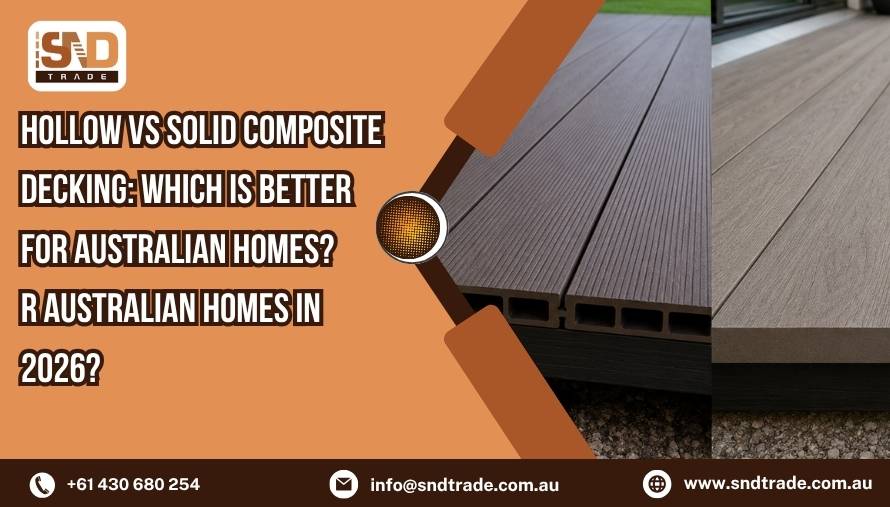
Choosing the right decking material can make a big difference to the comfort, appearance, and value of your outdoor space. Whether you’re planning a backyard entertaining area, a poolside deck, or a quiet garden corner, composite decking has become the go-to choice for Australian homes.
One question that comes up again and again is whether to go with hollow or solid composite boards. Both perform better than timber in most ways, but they’re not identical, and the right pick depends on your space.
If you’ve been searching for wood composite decking Melbourne, this guide walks you through the real differences between hollow and solid composite decking, where each one shines, and which is better for Australian homes.
What Is Composite Decking?
Composite decking blends recycled wood fibres with plastic polymers. The result is a board that looks like timber but skips most of the upkeep timber demands.
Compared to traditional timber, composite decking generally offers:
- Resists moisture
- Skips staining, painting
- Won’t splinter
- Handles termites better
- Cleans easily
- Lasts longer
That combination has made it a favourite across Australia, particularly in spots that cop a lot of sun and unpredictable weather.
Hollow vs Solid Composite Decking
Both board types use similar raw materials. What sets them apart is what’s happening on the inside.
Hollow Composite Decking
Hollow boards have chambers running through the core, which trims the weight without giving up much strength.
Advantages:
- Light to carry
- Fast installation
- Usually cheap
- Eases stress on the frame
Disadvantages:
- Not so stiff
- Requires endcaps
- May be hollow sounding
- Cannot carry too much weight
Hollow boards can be found on backyard decks where price and ease of handling are preferred over loading capacity.
Solid Composite Decking
Solid boards are dense all the way through, with no hollow core.
Advantages:
- Strong, durable
- Feels like hardwood
- Handles impact well
- Quieter underfoot
- Premium finish
Disadvantages:
- Heavier boards
- Costs more
- Slower to install
Solid decking tends to be the pick for busy areas and homeowners chasing that extra bit of durability.
Get a Free Sample
Not sure which material suits your project? Request a free sample and we'll help you pick the right fit for Melbourne's climate.
Request Free Sample →Wood Composite Decking Melbourne: Which Handles Australian Weather Better?
Australian weather doesn’t go easy on outdoor materials. Your deck deals with:
- Strong UV rays
- Heavy rain
- Shifting temperatures
- Humidity
- Salty coastal air
So when you’re weighing up wood composite decking Melbourne, climate needs to be part of the conversation, not an afterthought.
Hollow decking performance:
Good-quality hollow boards do well in homes when they’re installed properly with decent drainage underneath. They suit:
- Covered patios
- Garden decks
- Courtyard spaces
- Small residential decks
Solid decking performance:
Solid boards tend to cope better in spots that face:
- Constant sun
- Heavy foot traffic
- Outdoor kitchens
- Commercial areas
- Pool surrounds
The extra density gives them more stability when temperatures swing.
Which Looks Better?
Looks matter, since your deck becomes part of your home’s overall feel.
Both hollow and solid options come in timber-style finishes such as:
- Spotted Gum
- Blackbutt
- Walnut
- Teak
- Charcoal
- Ash Grey
Once installed, the visual gap between the two is small. That said, solid boards often feel a touch more upmarket, thanks to a firmer, steadier surface underfoot.
Comparing Hollow and Solid Composite Decking
| Feature | Hollow Decking | Solid Decking |
| Weight | Lightweight | Heavy |
| Price | Lower | Higher |
| Installation | Easier | More labour |
| Strength | Good | Excellent |
| Noise | Slightly hollow | More solid |
| Durability | Very good | Outstanding |
| Residential use | Excellent | Excellent |
| Commercial use | Limited | Highly suitable |
Which Option Offers Better Value?
Price alone shouldn’t drive this decision. Long-term value matters more.
Hollow decking may suit you if you:
- Have a tight budget
- Want a lighter build
- Have a small deck
- Need faster installation
Solid decking may suit you if you:
- Get heavy daily use
- Have pets, kids
- Want maximum lifespan
- Prefer a premium finish
For plenty of Australian homeowners, spending a little more now saves on repairs down the track.
Practical Tips Before Buying Composite Decking
Picking the board is just one part of getting this right.
Think about sun exposure
Darker boards soak up more heat. If your deck sits in full afternoon sun, a lighter shade will stay cooler underfoot.
Choose quality fixings
Hidden fixing systems give you:
- Cleaner look
- Even spacing
- Better drainage
- Less movement
Don’t skip ventilation
Composite decking still needs airflow underneath to stop moisture building up. Get this right and your deck lasts longer.
Buy from a trusted supplier
Quality swings a lot between brands. Look for:
- UV resistance
- Fade resistance
- Moisture protection
- Solid warranties
- Australian suitability
Common Mistakes Homeowners Make
Buying on price alone
The cheapest board upfront isn’t always the cheapest over 20 years.
Ignoring installation requirements
Even the best decking underperforms if it’s installed incorrectly. Stick to the manufacturer’s guidelines.
Picking the wrong board for heavy traffic
Busy entertaining areas usually do better with solid boards over hollow ones.
Forgetting expansion gaps
Composite boards expand and contract with the weather. Proper spacing during installation matters more than people expect.
Overlooking future maintenance
Composite decking is low maintenance, not zero maintenance. A regular clean keeps it looking sharp.
Which One Is Best for Australian Homes?
There’s no single right answer here.
For most family homes:
- Hollow decking provides excellent value, lower cost of installation, and longevity
- Solid decking provides increased strength, superior quality, and longevity
If you will be using the deck for entertaining purposes or furniture will be used often, solid planks would be the better choice in the long run. For a standard backyard space, hollow boards often do the job beautifully at a friendlier price.
It really comes down to your budget, your lifestyle, and how hard your deck will work.
Conclusion
The decision to use either hollow or solid wood composite decking should actually come down to the purpose for which the deck is going to be put into use. While hollow decks provide good value for money, a light construction, and reliable performance, solid decks ensure more stability.
For anyone looking for good wood composite decking Melbourne, it would be wise to choose a deck that has been specially designed for Australian conditions and to have it professionally installed from the very beginning.
Here at SND Trade, we have a variety of composite decking products designed for both beauty and functionality.
Frequently Asked Questions
Is wood composite decking Melbourne suitable for Australian weather?
Yes. Good-quality wood composite decking Melbourne products are built to handle harsh sun, rain, and temperature swings, with far less upkeep than timber.
Does hollow composite decking break easily?
No. Well-made hollow boards are built for residential use and hold up well when installed according to the manufacturer’s instructions.
Which decking is more durable?
Solid composite decks tend to be slightly superior when put through heavy use, but both will last many years provided the proper installation is done and maintained.
Are composite decks slippery?
Modern composite decks usually have a surface texture that prevents slipperiness, which needs to be regularly cleaned.
Is composite decking worth the extra cost compared to timber?
For most Australian homeowners, yes. It cuts down ongoing maintenance and skips the regular staining and painting timber demands, which adds up to solid long-term value.